Dark War Survival: Cross-Server Capital Clash (Guide + Tactics)
Cross-Server Capital Clash is a weekly, server-vs-server (war zone vs war zone) competition where regions earn points across multiple activities. The side with the highest points secures the right to invade the enemy capital, while the lowest-scoring side becomes the defender. In this guide, you’ll find a practical overview of phases, where points come from, and tactical priorities for both attackers and defenders.
1) Event Flow: What Happens on Which Day?
Matchmaking / Preview (Sunday)
- War zones are matched randomly.
- Use this day to review the opponent, available scoring methods, and coordinate alliance roles.
Point Race (Monday–Friday): “Invasion Right” Competition
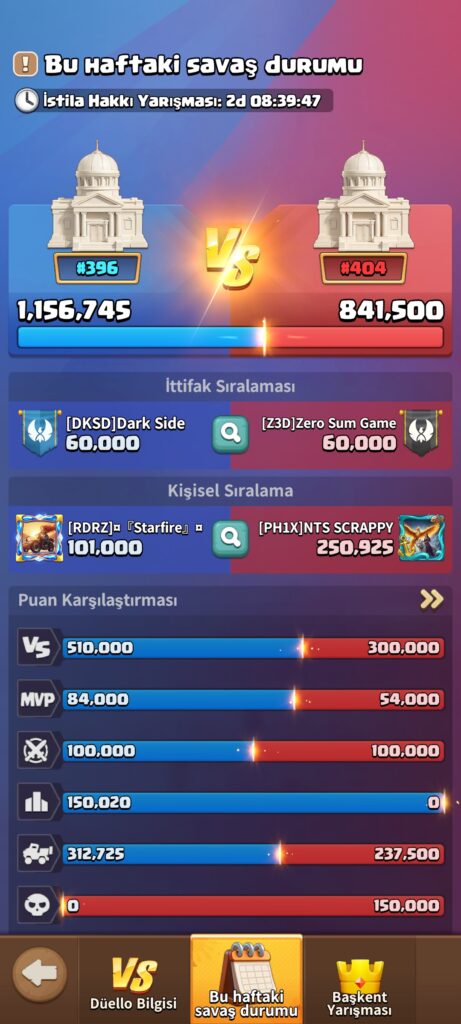
- Points are accumulated through multiple activities (duels, arena ranking, escort tasks, capital-related objectives, etc.).
- The war zone with the highest total points earns the Invasion Right.
- The war zone with the lowest total points becomes the Defender for the capital phase.
Capital Battle (Saturday): Attack vs Defense
- The invader can travel to the enemy region and attempt to capture the capital.
- The defender must protect ownership of the capital and prevent full occupation.
2) Win Condition: How Capital Capture Is Decided
- You win by occupying the enemy capital.
- If a side reaches 100% occupation progress during the conflict window, the occupation succeeds.
- If neither side reaches 100% before the period ends, the capital goes to the side with the highest occupation progress.
3) Reading the Scoreboard (Example Numbers)
During the week, you’ll see a live comparison between the two war zones. For example, a matchup might show something like #396: 1,156,745 vs #404: 841,500. Treat these as “moment-in-time” indicators—what matters is the trend and whether your team can spike points during key windows.
4) Where Points Come From (High-Impact Sources)
The event includes a list of extra point opportunities. Prioritize point sources with the best effort-to-reward ratio and those your roster can execute reliably.
Alliance & War Zone Performance (Macro Points)
- Top-10 Alliance Duel wins (war zone contribution): big burst points.
- Daily Top-1 within Top-10 alliance duels: steady repeatable points.
- Arena Rank #1: typically one of the largest single-point sources—plan your pushes.
Escort / Convoy Tasks (Consistency Points)
- Escort missions can yield points depending on whether a convoy is intact or has been looted.
- Best practice: run escorts when your alliance can protect routes and coordinate reinforcements.
Capital Objective Points (Tactical Micro Points)
In capital-related scoring, points often come from specific battlefield actions such as:
- Eliminating enemy troops in capital zones (including turret-related kills).
- Destroying or neutralizing scouting/observation structures and their defense points.
- Completing objective-based actions near capital or designated city boundary levels.
- Defense-time related scoring (holding/defending during key timer windows).
5) Tactics: How to Win the Monday–Friday Point Race
A) Build a “Points Calendar”
- Assign which alliances and players will push which point sources on which days.
- Plan your spikes around reset times and windows when opponents are typically weaker (time zone differences).
B) Focus on Repeatable, Low-Risk Points First
- Secure consistent points daily (duels, escorts, routine objectives).
- Save high-risk/high-reward pushes (e.g., top arena rank) for moments when you can defend the lead.
C) Prevent “Point Leaks”
- If escorts are being looted, you’re bleeding both resources and points—switch routes/times and escort in groups.
- Make sure top performers are not competing against each other unnecessarily; coordinate who goes for top ranks.
6) Tactics: Capital Day (Saturday) — Attacker vs Defender
If You Are the Invader (Attacker)
- Play for occupation progress, not random fights. Every action should increase your capture pace or reduce the defender’s ability to respond.
- Coordinate waves: rally timing, reinforcements, and travel speed advantages matter.
- Prioritize disabling key enemy structures and removing defenders from scoring/holding positions.
If You Are the Defender
- Your main goal is to deny 100% occupation and keep enemy progress as low as possible.
- Rotate defenders to prevent burnout; defend during the most impactful timer windows.
- Don’t over-chase: defending the capital is usually more valuable than trading kills elsewhere.
7) Rewards & Buffs: Why “Successful Attack” Matters
Successful attackers can earn special benefits that boost army and development performance. Examples include:
- Dominion Sword (example): Unit Damage +10%, Unit HP +10%, March Speed +5%
- Order Scale (example): Training Speed +15%, Building Speed +20%, Research Speed +20%
- Some results can also grant additional leadership/position slots tied to the capital’s leadership structure.
8) Critical Safety Tip: War Zone Hospital Deadline
One of the most overlooked rules is the hospital recovery window. In this phase, a large portion of dead troops may be treated in a war zone hospital. There is typically a limited time window (e.g., from Sunday into Monday) where rescues can be free, and a firm closing day where unrescued troops can be lost permanently. Treat this as a mandatory checklist item for leadership and all high-power players.
9) Quick Checklist for Leaders (R4/R5)
- Finalize daily point assignments and publish them to alliance chat/Discord.
- Coordinate top-rank pushes (Arena, duel rankings) so players don’t cannibalize each other.
- Schedule escort convoys when coverage is strongest.
- Prepare Saturday roles: rally leads, defenders, reinforcements, scouts, and structure/objective teams.
- Remind everyone about the hospital rescue deadline and confirm compliance.